Are Hares and Rabbits Really Different Animals?
- Hares and rabbits may look similar, but they are actually quite different animals.
From their body shape and ears to the way their babies are born,
there are several easy ways to tell them apart.
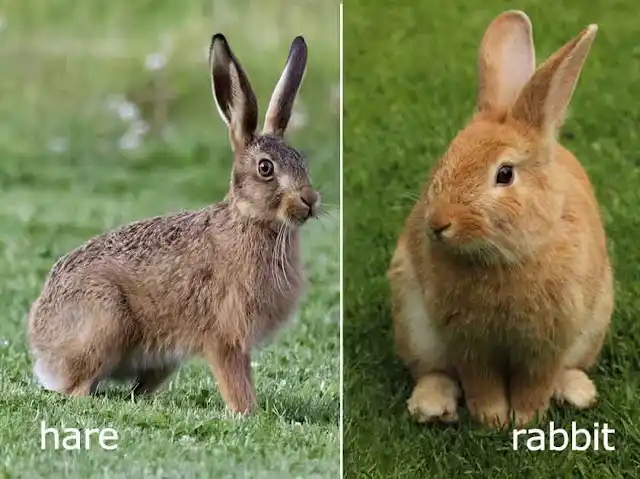
| Category | Hare | Rabbit |
|---|---|---|
| Classification | Wild Hare | European Rabbit |
| Chromosomes | 48 (24 pairs) | 44 (22 pairs) |
| Domestication | Cannot bedomesticated (strongly adapted to life in the wild) | Can be domesticated (commonlykept as a pet) |
| Physical Features | Long ears and powerful hind legs | Relatively shorter ears and legs |
- They may all look like rabbits, but hares and domestic rabbits are actually quite different.
- They have different numbers of chromosomes and are biologically distinct species, so they cannot interbreed.
How to Tell Them Apart by Appearance?
- One of the most noticeable differences is their ears.
- Hares have long ears with distinctive black tips.
- Their hind legs are much longer than their front legs, giving them excellent speed and agility.
- They can reach speeds of around 60–80 km/h, making them extremely difficult to
catch in a straight-line chase.
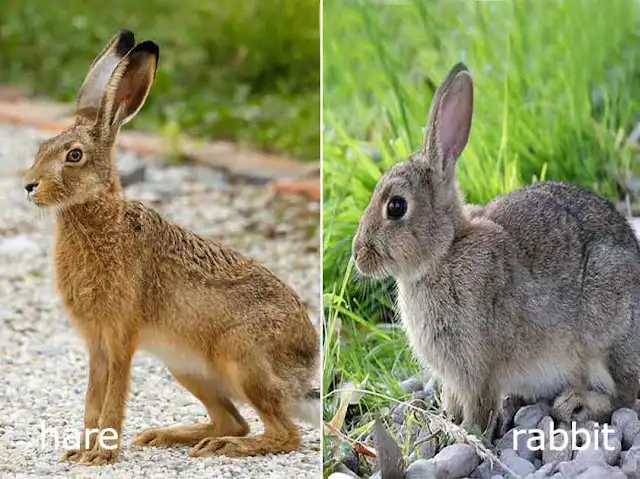
| Category | Hare | Rabbit |
|---|---|---|
| Body Shape | Slender andrelatively large | Rounder andmore compact |
| Ears | Long,often with black tips | Relatively shorterand smaller |
| Hind Legs | Long andvery powerful,built for speedand agility | Relatively shorter and less powerful |
- Domestic rabbits, on the other hand, can reach speeds of around 30–40 km/h.
- Rather than relying on speed over long distances, they use their quick acceleration to make a fast escape, often retreating into the nearest burrow for safety.
How to Tell Them Apart at Birth
- Hares are born relatively well-developed, so mother hares provide only minimal care, such as nursing.
- Domestic rabbit kits, on the other hand, require intensive care and protection
from their mothers for the first few weeks of life.
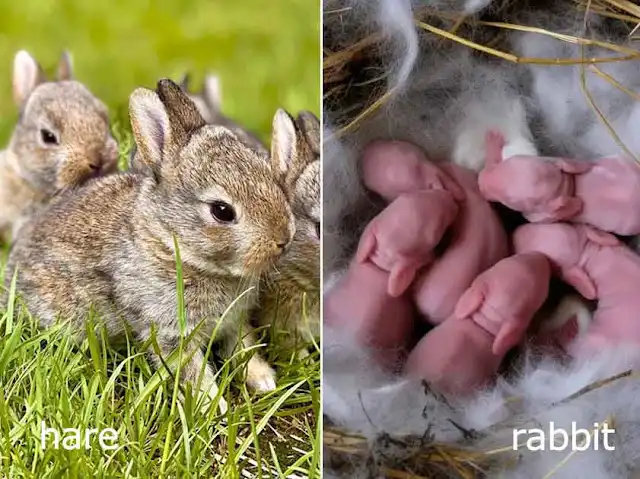
| Category | Hare | Rabbit |
| Eyes | Born with their eyes open | Born with their eyes closed |
| Fur | Born fully furred | Born hairless |
| Mobility | Can walk and run within minutes of birth | Unable to move around on their own immediately after birth |
How to Tell Them Apart by Their Lifestyle
- Domestic rabbits are social animals that live in groups and often make
their homes in complex underground burrow systems known as warrens. - Hares, on the other hand, are mostly solitary and tend to stay within their own territories. They shelter above ground, often beneath trees, in grass, or in the shade of rocks, and are mainly active at night.
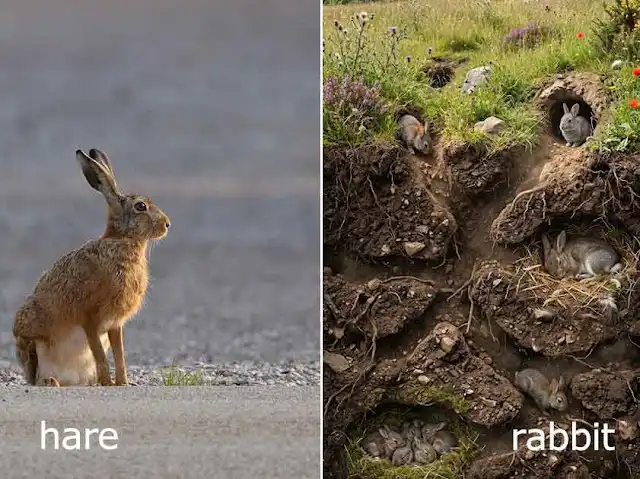
| Category | Hare | Rabbit |
| Habitat | Open areas such as mountains and grasslands | Lives underground in burrows |
| Social Behavior | Mostly solitary, except during the breeding season | Lives in social groups |
| Response to Danger | Runs away or stays still and hides | Thumps the ground with its hind legs |
- These very different lifestyles are another clear way to tell hares and rabbits apart.
Rabbit Teeth That Keep Growing for Life

- The teeth of both hares and domestic rabbits continue to grow throughout their lives, at a rate of around 10–12 cm per year. As they eat fiber-rich foods,
their upper and lower teeth constantly grind against each other,
naturally wearing them down and helping to maintain a healthy length.
Rabbits Eat Their Own Droppings
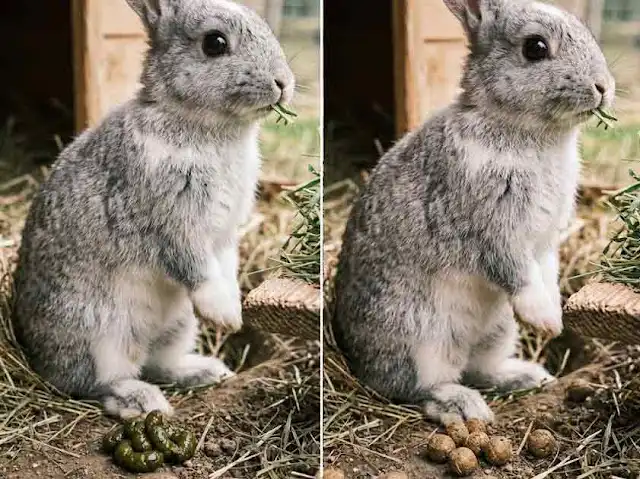
- Both hares and domestic rabbits digest their food through the same basic process:
mouth → stomach → small intestine → large intestine (including the cecum) → anus. - When tough, fibrous plant material reaches the cecum, it is fermented and broken down with the help of microorganisms. Both hares and rabbits then eat the soft, nutrient-rich droppings produced during this process, allowing the food to pass through the digestive system a second time and absorb additional nutrients in the small intestine.
Once the nutrients have been absorbed, the remaining waste is passed as the small, round, hard pellets we normally think of as rabbit droppings. Unlike the soft, nutrient-rich droppings, these hard pellets are not eaten.
This unusual digestive process is shared by both hares and rabbits. And while they may look similar, there are actually many fascinating differences between them. - Now that you know what sets them apart, the next time you spot a hare or a rabbit, go ahead and show off a little—you’ll know exactly which one you’re looking at! 😉